The short, direct answer is both yes and no.
The reason for two different answers up front unfortunately is because simply, not all properties and conditions are the same. As layouts of properties can vary greatly, slopes, shapes, conditions of soils, etc., for the sake of simplicity and to help address as many similar conditions as possible, this article is going to focus primarily on new pools being built in backyard areas of homes. There are conditions where pools can be built at the side of homes or even in front access areas that can relate to some of the points being highlighted as well potentially.
Some of the common main points that can affect a new drainage problem from having a new pool built are :
- Property Size on sides & rear of home : The size of the residential lot and the spacing between homes. Which we will get into.
- Proper Grading : The quality of the grading work following the completion of the pool.
- Home & Pool Decking Elevations : Existing elevation aspects of your property, also in effect from neighboring properties at times; effects of sloping, especially in backyard.
- Desnse soil conditions & Existing Drainage Challenges : If existing challenges are present for drainage problems with your home or a notable amount of homes in your neighborhood, before your pool is built.
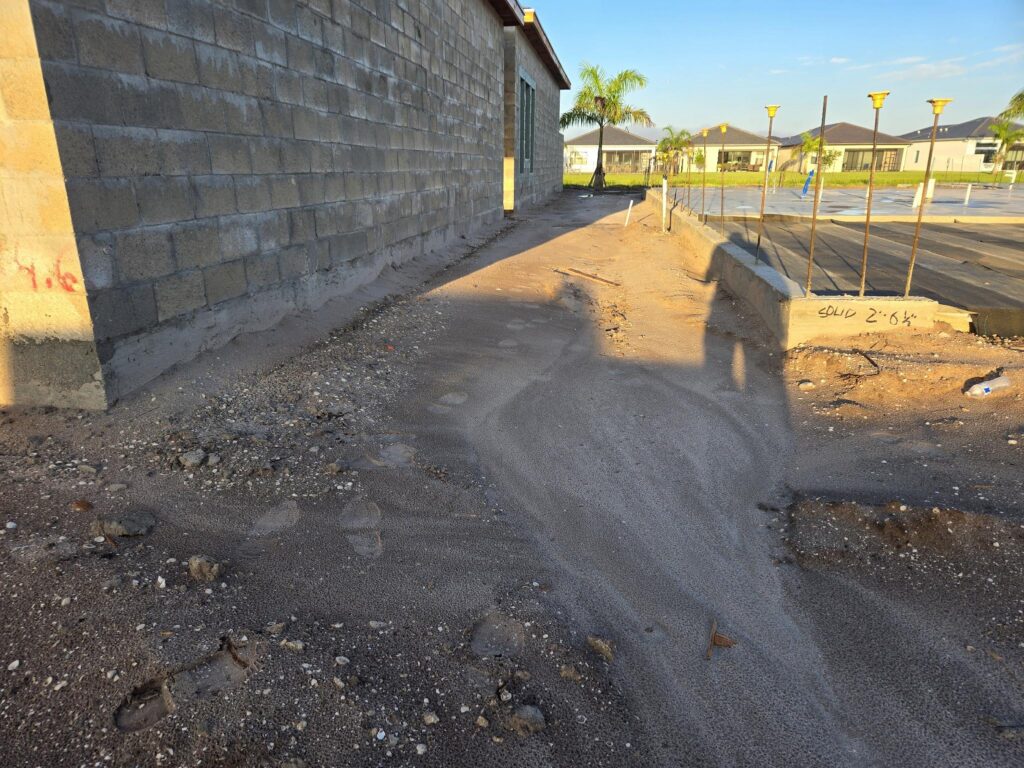
- Property Size on sides and rear area of home : With an increasing number of new home developments, property sizes are getting smaller and smaller as an ongoing trend it can be said for generations. Many new home communities in our own immediate area, we’re seeing new, middle to high end homes with as little as 6 feet or less space outside the walls of a residential home to the property line they share with a neighbor.
Eight feet of property on the side of a home to ten feet of space on the side of a home between neighbors of new homes being constructed is more common than uncommon for many beautiful new communities we see in our work serving the design & construction of beautiful new outdoor makeovers for our clients.
This aspect of Property Size is the first factor we mention as it has a great impact on the problem some people face. Nothing they did wrong. Nothing the developer or pool contractor necessarily did wrong. The amount of space, the smaller the distance between the homes, the greater the potential for drainage challenges in many situations it may be found. The other factors mentioned also play into the equation, but this issue of spacing, the “Property Size on the sides and rear area of the home” may often be seen as the greatest influence for potential drainage challenges and we will go into some reasons why, and how it can be addressed and either avoided or overcome.
When you consider the total area of a property, the total square footage of the lot that the home is built on, for many of these homes that leave little perimteter space, example 6 to 10 feet on the side of the home, this is the natural area, often where the lawn and or landscape exist to help to absorb the natural rainfall on a property.
To note, some lots can be large in size with small areas on the sides, as well as the front and rear areas of the home, mainly as the homes themselves are maximized for the spacing. The dedication to the lots in some communities to placing the largest homes possible per lot size, with less emphasis on the benefits of having land and yard space. Different communities, different priorities simply.
For these residences with the lot size maximized for the home, think again of the total square footage of the entire property and in many of these situations, consider the total square footage of the footprint of the home itself.
The total square footage of the roof alone of the home in many cases with these small side areas on the sides of the home, the home itself represents the overwhelming percentage of space on the property.
The overwhelming percentage of square footage of the home in many cases might be found represented by house. Then there is the consideration of the driveways, walkways and patios.
The greater the square footage of the property is taken up by the home (or building in commercial applications), the less green space, the less lawn and landscape, or for measuring ‘Permeable space’ area there is to account for the natural absorption of rainfall for a property.
Also, with more water pouring from the roof or gutters from a larger space, a home that takes up the majority of the lot or space the home sits on, that larger volume of roof water is flowing into less space to handle that water flow.
The result, more and more communities are requiring grading inspections before a pool can pass final inspection, which is a good development. Pool construction is being required in many newer communities to account for drainage inspections, grading inspections, even before the fencing around the new pool is being required.
A note, even with drainage and grading inspections, problems can develop with drainage that did not exist before. The other factors we note can play a factor, but if you’re living in a community that is requiring grading and / or drainage grading inspections before a pool can pass a final inspection during construction of a new swimming pool, that is a good and helpful point that can help protect against having future, potential drainage problems.
Final grading inspections should account for drainage concerns before a pool is finalized and will usually occur in the pool building process when all of the remaining soil from the initial pool dig is being removed from the property and the grade level for the new pool patio is being established. At that point, after that final soil removal, is the point before the new pool deck is installed where this final grading inspection typically occurs.
Special Note : if you’re considering or needing to install new PVC Drainage Piping to help prevent drainage issues with your new pool, the best time to install in the back of the home is BEFORE the new pavers or pool deck is installed, while there is still open soil that can be worked in.
This prep work for drainage piping sleeves at the least is for areas to connect to existing or new roof gutter downspouts that the new drainage should connect to. If these gutter downspouts are at an area that is to be surrounded by new pavers or concrete pool decking, if there is NO PIPING attached to these Gutter Downspouts, once the new pool deck is installed, these gutter downspouts will have water outflowing ONTO the new pool patio.
The example we use in these sequence photos here is for a pergola that was
added to the rear covered patio of a home to increase the covered outdoor living space. The pergola had a drainage downspout, outflow point, similar to any home gutter downspout and the water poured from this new structure onto the patio. With the volume of water during heavy storms, it was flooding the covered patio area regularly so this water that was collected from the pergola and was released through the outflow point represented where our 4” PVC Drainage piping connected to, was necessary to help remove the water from the area. This water tied into a drainage system that tied into the gutter and pool deck channel drains that released the water outside into an easement off the property to release into the development’s easements and larger water collection plan for the community.
For those in Homeowner’s associations, tip and a helpful one even if you’re not in an HOA, get a drainage plan from any contractor that you’re hiring. Should be a diagram at the least on a copy of your property survey. For those in Hoa’s it is typically required to submit a drainage diagram, and simple diagrams as this one included here, for this pergola drainage project are usually appreciated and accepted widely.
To avoid this, if you have gutter downspouts in the back of the home, in the middle of the deck or not at the edges of the home or new pool decking, and the gutter downspouts will flow onto the new pool decking, it is advised to prep for this and have new PVC Drainage Piping (typically 4” or larger, for most homes and small building) sleeved in below grade, before the new pool decking is installed. This can help to alleviate the expense of lifting a new patio and installing drainage piping later if necessary. Always easier to install before the patio is in place.
- Proper Grading, following the completion of the new swimming pool
This is the second point we address as proper or improper grading can have an effect on absolutely any property, regardless of the size of the lot the home and pool sits on.
To put it simply, bad work, work that doesn’t account for the pitch of the land towards or away from a home or building, the need properties can have need for in swales or retention areas can create problems.
There are some different nuances that can play a factor in this. Some we address in the points that follow, but for grading, to put it simply, there are points that are required to help solve drainage problems, and to know them in advance, can help to avoid any potential problems from arising, if thinking of them in advance.
The grading should be a pitch to help move water away from a home or structure. When water is trapped on a property, without re-moving surface materials, hardscapes, etc., a standard approach we suggest to solve trapped water by a home or foundation focuses on how to remove that water simply.
Example, when solving drainage problems, we frequently tell clients and those inquiring of us, that drainage solutions need to address 3 SIMPLE QUESTIONS :
- How will the water be collected ?
- How will the water be moved ?
- Where will the water go ?
If any potential drainage solution does not address these 3 simple points adequately, we advise not to put too much stock in the advised solutions.
Water will only leave an area typically by a few different means :
- Water will seep into the ground, natural absorption by the land. To note, the smaller the open ground for lawns and landscapes, the reduced ability for natural absorption in comparison to larger paved and roofed structures (homes, buildings) on a property. As noted in the Property Size section of this article.
- Gravity : water will go downwards, or downhill. This is the easiest way to understand or see water leaving a property naturally quite often.
- Pressure, with force : Water can leave an area by being pushed out, similar to a head pressure from a pump. The way a sump pump will push water out of an area, a gutter downspout where water flows out of that is collected from a roof also has a ‘head pressure’ and will push water when harnessed into a drainage system. (We have articles and depictions of this on our website as well in other articles with interest.)
Considering how these aspects are required to solve drainage problems, as this point of “Proper Grading” is a controlled point during the construction of a pool, not creating an area that water can not leave during a storm is the first, greatest point possibly to consider.
If the soil is left in place around the pool at an elevation that is higher than the new pool patio, this will trap the water on the new pool decking.

If the soil, the finished grade and landscape level is at a higher elevation surrounding the new pool patio, the water that is collected naturally on the pool deck during a storm will be trapped and not able to leave the pool patio.
There must be an area that the rainfall collected during a storm can go to naturally that is lower than the new pool deck or quite simply, the water will be trapped.
This can happen when not enough soil is removed from the excavation process of digging the pool and not accounted for during the final grade. A final grade that is done, before the pavers or new concrete pool deck is installed, and does not account for this need for the water to be able to drain from the pool area, is a cause of this problem in many cases it can be thought.
- HOME AND POOL DECKING ELEVATIONS:
Another factor that can develop is when a backyard behind a home has a slope that isn’t noticed or accounted for very well and then the new pool is installed and the deck is noticeably higher, maybe even needing a step or two (or more) at the end of the pool deck that is opposite the house.
This happens as the property has a slope that goes lower the further from the foundation of the home. If this is not accounted for, there will be a drop off on the side of the pool decking. Doesn’t happen as much in South Florida as it can in many other areas, as the elevations in our region are very flat and level for many communities.
This slope adjustment can be accounted for by using fill on the sides of the new pool deck area to help eliminate the drop off from the pool patio, for a safer walking surface without a drop, however, again, especially with smaller properties, if the soil is built up and the need for drainage not accounted for, this can push your surface water on some properties to the neighbors.
Always best to think of a long series of heavy rainfall storms, weeks of heavy rain when planning or thinking of drainage. Plan for the big events, then the common shouldn’t be an issue it might be thought.
If you can control the water runoff from your home and patio and paved areas on your own property, without it effecting your neighbor, that is the goal. Not to push your problem or your water onto your neighbors, the same as you would wish them to do that to you.
This can be done more easily on lots that might have 8 or more feet on the sides of the home, even though, again, not all situations of construction are the same and neighborhoods with different builders, or custom builders from one lot to the next could have situations with newer homes that go up, with a higher elevation from the foundation of the home, better for a home to have, that can create an issue sometimes for older, lower elevation homes. That is a different situation.
All things being the same, with the elevations from neighboring houses (or buildings) level, and not creating problems for each other, with backyards that have a slope that is noticeable, creating a step down or two in height by the far end of a new pool deck possibly, the way the grading is handled can create a drainage challenge for a neighbor if consideration isn’t given sometimes into how the water collected from the home and patio can leave the property.
In our primary service area of South Florida and Palm Beach County, the western communities will tend to have poorer draining soils, which will result in more drainage challenges.
If uncertain if this the grading will present a challenge for drainage from your new pool, the smaller the property and the larger the decline in the slope in your backyard could be a good point to stop and consider this during, or maybe having to think of this and address it later.
Drainage systems, with PVC Piping can often be the most effective and cost efficient way to address this particular problem before, during or after the pool construction process sometimes.
Best way to avoid improper grading problems, to be aware of the importance beforehand hopefully.
- Dense Soil Conditions & Existing Drainage Challenges :

This one may the easiest to help you prepare before your new pool is built. If you have existing standing water behind your property, or on the sides of your home, there is a chance that this can increase. It is relatively simple to deal with by installing a proper drainage system. And there in lies the challenge for many, again, when determining a proper working drainage system, we have illustrations and photos of projects and the materials being installed on our website to help understand how they work and also, why they work.
As the natural surface area, the open lawn or landscape area of your home’s property is being reduced, the natural absorption areas and runoff areas for natural rainfall is also being reduced.
This can be made up for with piping water away from your property and your home to allow for the reduced natural surface area that your property had before your new pool.
We deal with creating beautiful spaces, beautiful landscapes are a natural, primary component of what we do. Having an area that provides and accounts for the natural needs of rainfall and drainage for an area helps to provide a longer lasting, healthier landscape. Good drainage, good water flow accounting for heavy rains is a FUNDAMENTAL and FOUNDATIONAL level component of delivering a quality landscape project.
As patios, home additions also have an effect on a landscape, the landscape is the component at the end of the construction process, needing to help adapt to the new conditions of the home or structure and conditions of the land. It is a natural role for the landscape to help account for the natural, rainfall needs of a home and property, as the conditions that are created don’t usually worry about the drainage needs, just what is the beautiful new home or building or pool area going to look like.
The drainage is not thought of much at all.
However, as new home developments in many areas trend to having smaller lot sizes with bigger homes, the drainage component becomes less able to be ignored and more present in planning needs.
Those communities that plan for the drainage needs better than others, the homeowners may see less needs for after construction drainage adaptions and additions.
Not always easy to account for, the soil is not the same everywhere and that is a major factor in drainage challenges.
For example, homes in the east part of our South Florida area by the coastal towns and cities here, and throughout Palm Beach County, Florida for example have more sandy soils, which are naturally great for draining quickly as sand is very porous and able to allow water to flow through very, very easily.
Bad planning or over development of a property can create drainage challenges even on these properties.
However, the western communities of our South Florida, or Palm Beach County, Florida areas have typically marl or a thick muck, soil. Can be very healthy, dark brown, rich black soils that are great for planting in, but also presenting a thickness that does not absorb rainfall easily and can leave water and root systems in some dense soil conditions where roots can struggle to grow at all for example with new trees and even an inch of root growth in a years time, in very dense soil, undraining conditions we have seen.
The density of the soil in an area can vary even from one home to a neighboring house’s property. Soil may be thought in some terms of larger veins or arteries of density in the ground throughout larger areas. Trending of a typical soil density for a larger area, city, town or neighborhood. However, even as a larger area can typically have a dense soil, or a well-draining soil in an area it might be thought by some, there can be pockets that open up, that might favor or disfavor a home, with either well-draining or poor-draining soil conditions that are notably different than a neighboring property.
The factor of soil density is a large factor that can affect the drainage challenges or provide conditions that eliminate drainage challenges from any property, based on their location and the soil density conditions of any individual property.
To sum it up, if there are a lot of homes (buildings) amongst your immediate community that have notably had drainage challenges, it would be best to be aware and thoughtful to allow for a drainage system in advance possibly. Hopefully you won’t need it. At the least, if you prepare some 4” drainage sleeving (larger for homes that are larger than average, or 5,000 sq. ft. roof and above possibly) ; if you install sleeving from your gutter downspouts that are at the back of your home before the new decking, if those downspouts are to be surrounded by new paver patio, at the least, this might be doing yourself a favor. If it’s not needed, great, if it is, this one small preparation can help to potentially save you from unnecessary aggravation and increased expense later.
We hope any might find this information helpful, and if we are able to help even one person experiencing a problem with this or to help anyone avoid a potential drainage problem, we are hopeful for that.
If you are in our service area and looking to create a beautiful new landscape, a property or backyard makeover, we hope you will consider us. We will work hard to make you glad you did.